Green Fidelity
"Come thou, I charge thee, to the Green Chapel"

Author’s Note: This Wednesday essay is free, but paid subscribers gain access to a narrated voiceover and a bonus section with tangible suggestions on how the reader can live a more rooted life through the ethos of the writing. Thank you for supporting Echoes from an Old Hollow Tree.
It is crucial you read Sir Gawain and the Green Knight this time of year.
It is crucial to be reminded of oaths—of fidelity—here at the mid-winter turning.
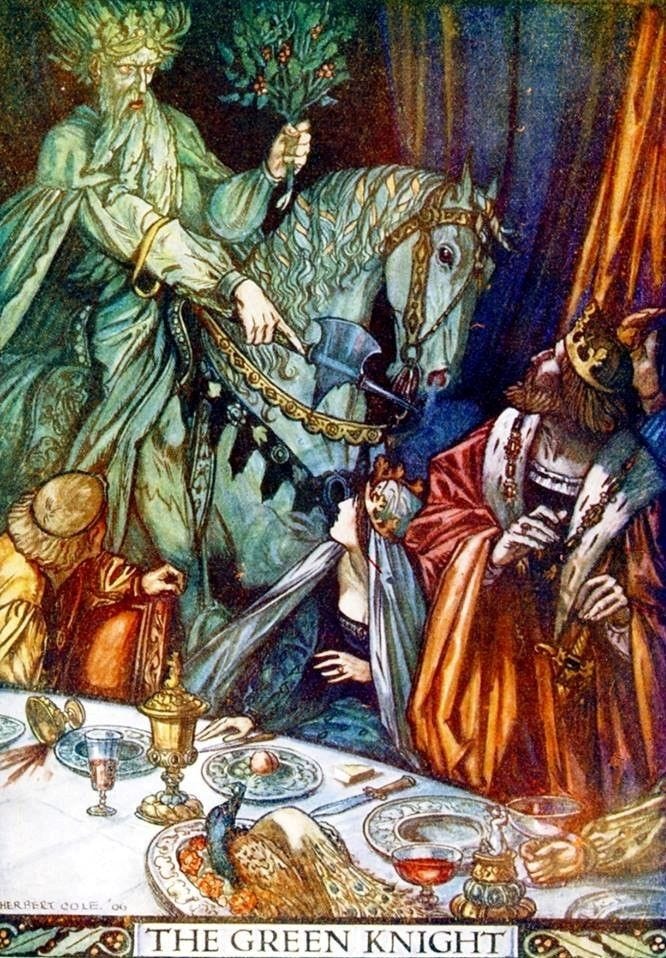
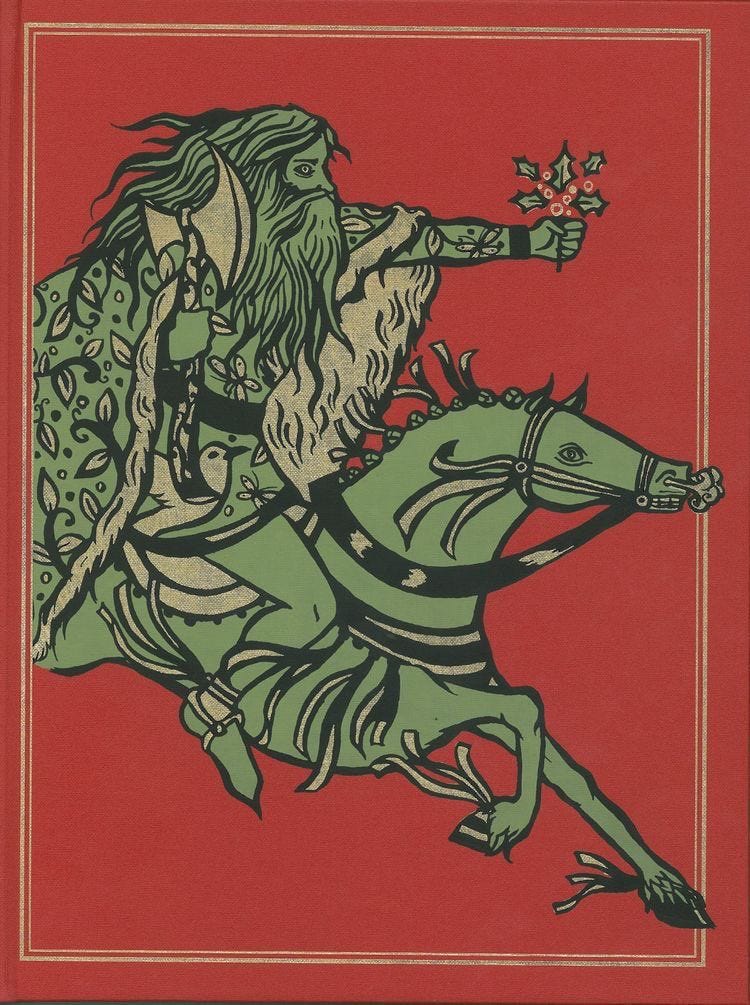
In the old legend, the Green Knight rides into King Arthur’s court during the Christmas season, when the hall is bright, the tables are crowded, and courage still enjoys an audience. He is immense and green from head to heel, bearing axe and holly, brimming with a vitality that is simultaneously wild and horrifying.
…in one hand he had a holly-bough, that is greenest when the groves are bare, and in his other an axe, huge and uncomely, a cruel weapon in fashion, if one would picture it.
He bears a challenge that carries the tone of a game until it settles into something dark and binding;
Therefore I ask in this court but a Christmas jest, for that it is Yule-tide, and New Year, and there are many here. If any one in this hall holds himself so hardy, so bold both of blood and brain, as to dare strike me one stroke for another, I will give him as a gift this axe, which is heavy enough, in sooth, to handle as he may list, and I will abide the first blow, unarmed as I sit.
Gawain accepts, strikes the blow, and watches with astonishment as the Knight lifts his severed head from the floor, eyes open, voice steady. Headless but enduring, he reminds Gawain that he must come to the Green Chapel in one year and receive what he is owed or be deemed a recreant. This is worth noting, as it is slightly but markedly different from being branded a coward. Recreant is from old French, and if we break down the etymology, it is something like cowardice but more specifically “surrendering oneself to distrust”; to become a recreant meant to be a particularly low flavor of coward, an unfaithful coward.
Come thou, I charge thee, to the Green Chapel, such a stroke as thou hast dealt thou hast deserved, and it shall be promptly paid thee on New Year’s morn. Many men know me as the knight of the Green Chapel, and if thou askest thou shalt not fail to find me. Therefore it behoves thee to come, or to yield thee as recreant.
The power of the story rests here, in Gawain’s obligation, his deal and blow struck with the Green Knight. It makes us think about to what we are bound, to the long good interval between vow and fulfillment when the road ahead is cold with winter dark. The Green Knight exists to see whether a man will live under the weight of his own word once the brightness of the feast hall has faded and only the work remains.
We ourselves arrive at that same threshold each year as the solstice passes. That good old day marks the turning, the longest night giving way to the slow return of light, and nothing about this change is sudden. The days remain short, the cold still presses, and we are tasked with keeping to our place and our people in spite of the cold and still-long nights.
The fire must be fed again.
The animals must be checked again.
But the day lingers longer by a golden sliver again.
We are learned and know this is the cause of the world’s tilt, of astronomical machinations. Despite this, it is hard not to hold on to the good old beliefs of our forebears that we are responsible for summoning the light back, for evoking the sun to rise a little higher in the sky each day with fire and with feast. Such is the work of keeping time honestly. We coax the light back through attention and through presence:
A porch light left on so the neighbor knows he is not alone.
A candle placed in the window as evening closes in.
A bonfire lit at the edge of the year.
Though it be tempting to rush the year along, to retreat to warmer climes and leave our towns and villages to fend for themselves, these little acts of illumination acknowledge our place within the cycle, our belonging to it. Fidelity here is a form of watchfulness, the discipline of remaining present while the change comes quietly, measured in minutes of daylight gained and the slow ascension of the sun’s good arc along the ridgeline.
Fidelity also names our obligation to place and people and the work that binds them together. I often speak of tradition, yet fidelity more accurately describes for what I am attempting to advocate, for the posture required. Tradition can be hollow, held onto for the wrong reasons, kept without really being useful to the people it would serve. It can be achieved with a sort of emotional distance. Fidelity, however, demands nearness. It asks whether we are staying true to a place by learning its needs and limits over time. It asks whether we are caring for land so it can be passed on without loss. It asks whether we are present to children as they grow and to elders as their strength wanes. Fidelity lives in the daily labor of keeping what has been entrusted to us intact through use and care: meals prepared, repairs made, seasons marked. These acts are quiet, repetitive, and they shape a person precisely because they require you to be there. Fidelity resists drift by rooting us in responsibility freely accepted. It forms people who understand that belonging is sustained through continuity, through showing up again in the same places with the same intention, through carrying weight without complaint.
The Green Knight returns at the end of the tale to see what has become of the promise he demanded. The road to the Green Chapel is cold and solitary, and Gawain rides it knowing the cost. He goes because fidelity has already shaped him into someone who cannot turn aside. That question rides with us as the year turns.
Are we keeping the obligations we have taken on?
Are we tending the fire when the wind claws at the door?
Are we faithful to the land and the people entrusted to us after the ease of summer has gone?
The darkest night passes. The light returns with the coaxing of something steady refused to be let go. Fidelity is that steadiness. It is the strength that holds when distraction tempts and fatigue presses. It is the quiet courage to live beneath our own words.
When the Green Knight calls for an accounting, he is asking the question every season asks of us:
Did you go where you said you would?
Care for who needed you?
Were you there?